The Aurora Chaser's Guide
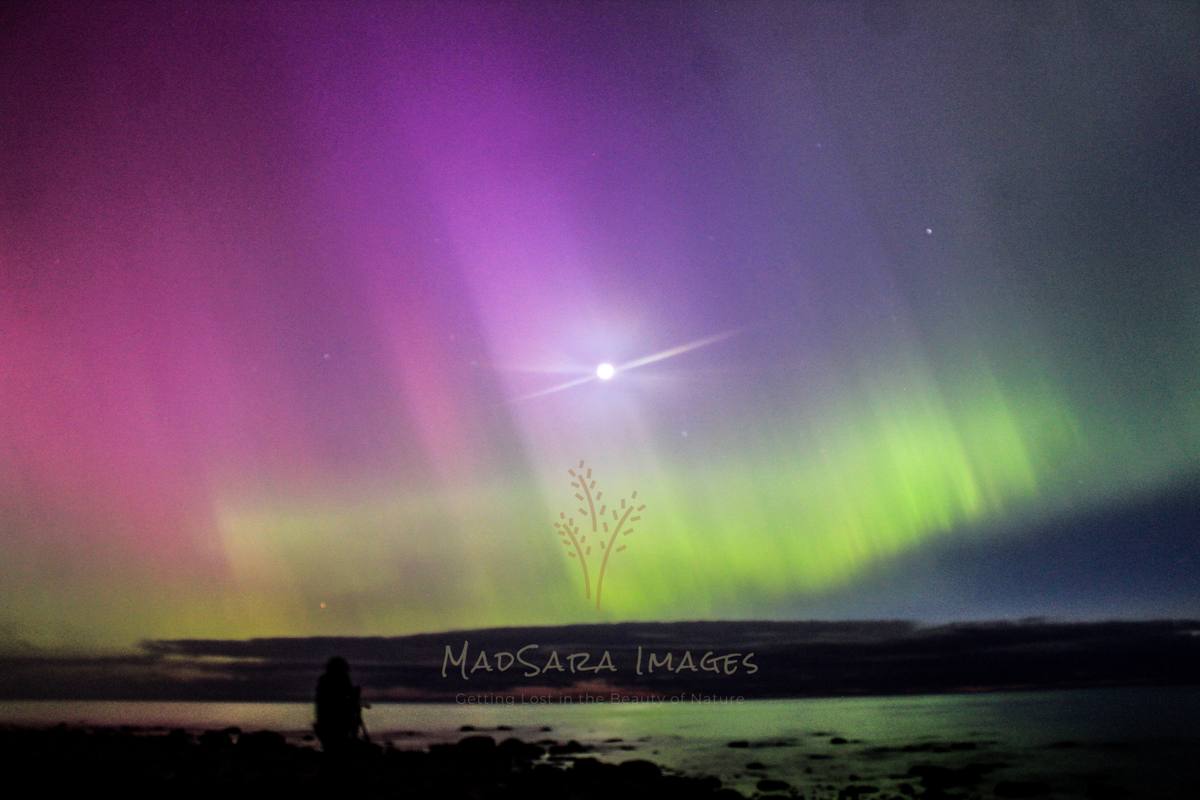
How To Use This Guide
Dream of seeing the sky light up in magical dancing colours for hours on end in Ontario, but always seem to be the one missing out? You're in the right place. Watch and wait with the imagination of a child and the patience of her mother. Take in the silence, the scents, the peace, and soon the magic will come.
This guide was not written in a classroom or a laboratory. It was written from dark fields beside Ontario lakes, from gravel shoulders on rural roads, from a beach I've stood on alone hundreds of times while the rest of the world slept. Written by someone who shoots with cameras held together with Krazy Glue, tripods salvaged from another era, and kit lenses that have no business producing the images they somehow produce.
I am someone who has been captivated by the aurora for as long as I can remember, and spent the last decade pointing a camera at it. The first five years I chased hard. Then solar maximum arrived and spoiled us all so thoroughly that the quieter nights stopped feeling like enough, as tends to happen when the sky has been that generous. What this guide contains is that accumulated attention, organized into something I hope serves you well in the field.
One important note before you go any further: this guide is not a forecasting tool. It touches on data and decision-making, but if you want to truly understand aurora forecasting, the kind that is pragmatic, honest, and grounded in the best science available, follow Scott, Kyle, and the moderation team at Ontario Aurora Chasers on Facebook. Learn the language they use. Read the updates. Ask questions. That community exists precisely for this.
There has been a lot of disappointment in the chasing community lately, driven by hype and under-educated forecasting. Space and earth weather alike have the ability to fool even the most seasoned observing scientists, which is exactly what makes a capture so thrilling, especially in the off season. This guide is everything else: the gear, the sky, the field, the light. Use it as a foundation. Pair it with the knowledge side of things that the OAC community builds in real time. The sky wins every argument.
Some nights you will stand under a sky that moves you so completely you forget to breathe. Some nights you will drive an hour into the dark and come home with nothing but the quiet and the stars. Both nights are the right night. The ones that give you nothing teach you everything. The ones that deliver, and they will deliver, will pay off every patient hour you ever spent waiting.
I have missed more shows staying home than I have ever missed in the field. A thousand nights I didn't go. Don't be me on those nights. The aurora does not care what camera you're holding or how much you know about solar wind.
Happy Chasing Friends, Sara, MadSara Images
Key Concepts for
Understanding Aurora
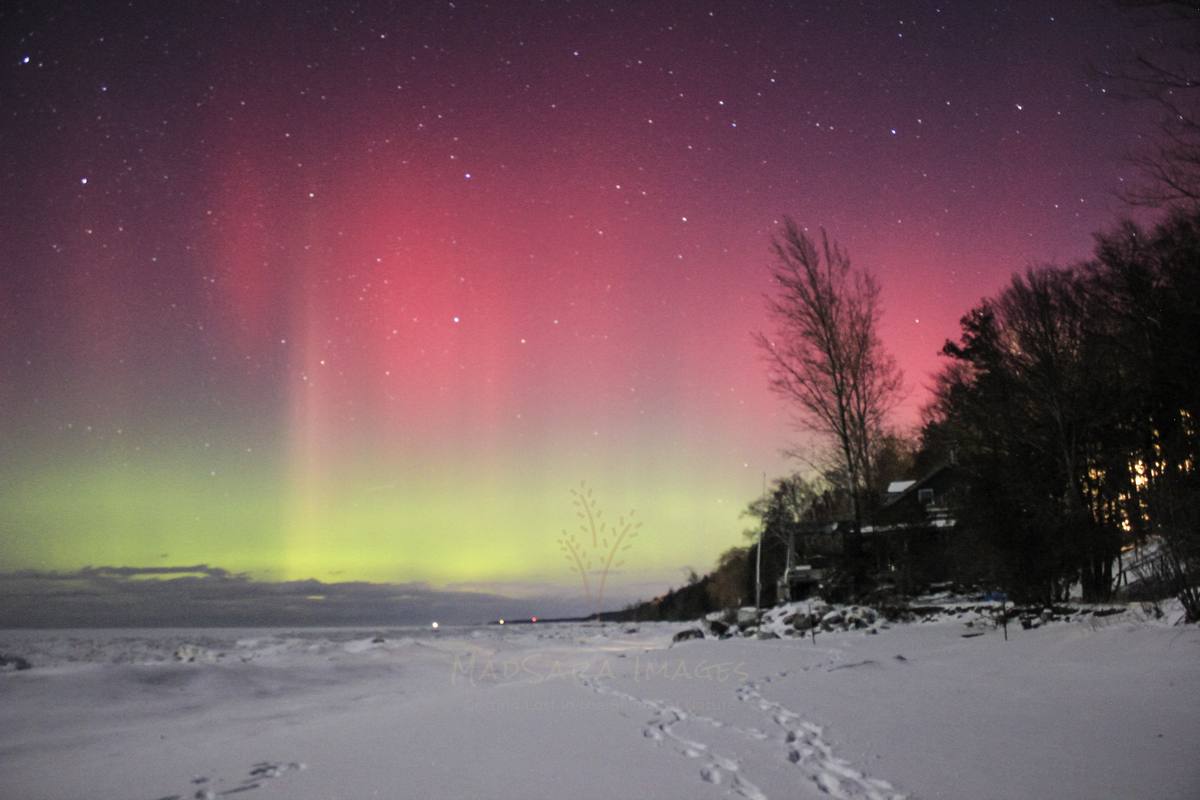
The magic of the night sky typically happens when the sun's active regions face Earth during its 27-day axial rotation. To begin exploring this phenomenon, here are the key terms you'll encounter, not as homework, but as a language. Once you know the words, the sky starts to tell you things.
- Active Region (AR): A concentration of magnetic activity on the Sun's surface, typically containing sunspots, that is the source of solar flares and Coronal Mass Ejections. When you see a numbered active region facing Earth in the news, pay attention.
- Sunspot: A cooler, darker region on the Sun's surface caused by intense magnetic fields. They appear dark because they are cooler than the surrounding photosphere, and they are the visible marker of where the action is happening.
- Coronal Hole (CH): A dark region on the Sun where magnetic field lines stretch open, creating a highway for high-speed solar wind to escape. These can persist for several 27-day rotations, making them the most predictable recurring source of aurora activity.
- Coronal Mass Ejection (CME): A powerful solar blast that strikes Earth's magnetic field like a dense storm front. The flare is the lightning. The CME is the storm that follows.
- Interplanetary Magnetic Field (IMF): Magnetic lines from the Sun that cross through space to engage with Earth's magnetic properties.
- Solar Wind: The aurora's primary fuel, a steady stream of charged particles flowing from the Sun's atmosphere. Everything else is just determining how hard and how effectively it hits us.
- Magnetosphere: Our planet's protective magnetic shield that redirects solar particles toward the polar regions.
- Bz (B-sub-z): This acts as a magnetic gateway. It should be oriented south (negative) to allow solar energy to penetrate Earth's field. The most important number you will ever watch.
- Substorm: A rapid discharge of energy in space that triggers the bright, moving dance of the lights. The rubber band snapping back.
- Magnetometer: A ground-based instrument that measures changes in Earth's magnetic field in real time. When the needle swings sharply, especially the H component diving negative, a substorm is likely in progress. Watching a magnetometer during an active night is one of the most reliable ways to know the snap is coming before it arrives. SpaceWeatherLive has a North American magnetometer chart that is practical for field use. SuperMAG has deeper Canadian station data if you want to go further.
There are two main ways the aurora reaches you. Understanding which one is driving on any given night changes how you plan your chase.
- CIR (Co-rotating Interaction Region): The Sun's steady heartbeat. Occurs every 27 days as fast solar wind from coronal holes overtakes slower wind. Predictable and persistent, a useful reference point for timing your watch, not a promise. Treat it as a guidestone, not a guarantee.
- CME (Coronal Mass Ejection): The climactic explosion. Sudden, violent, billions of tons of plasma. Can override the 27-day rhythm entirely and trigger extreme storms. Unpredictable but unforgettable.
When a coronal hole is active and Earth-facing, it will return to an Earth-facing position approximately 27 days later. Mark the date of any significant show on your calendar and watch the 27-day window forward. This is what separates experienced chasers from lucky ones. You stop waiting to be notified and start anticipating.
More activity in March and September is not a coincidence. It comes down to orbital geometry: around the equinoxes, the angle at which the solar wind meets Earth's magnetic field becomes statistically more favorable for energy transfer. Scientists call this the Russell-McPherron effect. The short version is that the Bz is more likely to flip south and crack our shield during these windows, even when solar wind is otherwise quiet. More likely, not guaranteed.
Gear-up windows: March through mid-April and September through mid-October tend to see elevated aurora activity. These are probability windows, not promises. Space weather does not read a calendar. But if you want to be ready for the best odds, this is when to have your gear ready and your eye on the data.
Read this before the table: These visibility ranges are approximations based on averages. Sometimes they hold. Sometimes they do not. Space and earth weather alike have the ability to fool even the most experienced observing scientists. Use this table as a loose guide, not a contract. Sometimes, but not every time, and it is important to know and respect that.
| G-Scale | Kp | Level | Aurora Visibility (approximate) |
|---|---|---|---|
| G1 | 5 | Minor | Sometimes visible at high latitudes, occasionally southern Canada |
| G2 | 6 | Moderate | Sometimes visible in Ontario under dark skies, worth watching |
| G3 | 7 | Strong | Often a good Ontario chase night. Sometimes exceptional. |
| G4 | 8 | Severe | Sometimes visible well into southern Ontario. Rare and memorable. |
| G5 | 9 | Extreme | Sometimes visible at latitudes that rarely see aurora. Rare. |
At 43.5°N, roughly Southern Ontario, a G2 to G3 is sometimes your sweet spot. Sometimes a G2 delivers nothing. Sometimes a G1 surprises you. Your best chances lie in the following mindset; don't chase the Kp number. Chase the Bz.
The Go / No-Go
Decision
A note on how I actually make chase decisions: part instinct built over years, part moderator chat in OAC where the people who know their data are talking, part my own shorter-term read of the numbers explained in this section. I evolved from chasing every single night and using that as my own informal science, to someone who is older, tired, and considerably less willing to stay awake for the hell of it but still very much driven by FOMO on any night the sky looks like it might perform. That is the honest version.
Three data points are what you need to make the chase decision in the moment. But sometimes waiting for them means missing it. Becoming familiar with the broader picture matters more than any single number. Whether a flare is Earth-facing is really the beginning. From there it's wind speed, how fast the solar wind is travelling, and how deeply our magnetic field absorbs the impact. I want to be honest here: I understand enough of this to chase, but the deeper forecasting knowledge belongs to people who have spent years living in the data. Scott, Kyle, Alex, and Evan at Ontario Aurora Chasers are those people. They call impacts, read the solar wind, and explain what is actually happening in real time with a level of understanding I genuinely respect and am still working toward. I have seen impact called with no wind behind it. That happens. Space weather humbles everyone, and the people who say otherwise usually have not been at it long enough. Solar flare and coronal hole alerts, community posts, the conversation in OAC, that is your early warning system. Open SpaceWeatherLive on your phone or laptop, tap the three lines in the top right corner, select Auroral Activity, then select it again to open the full live dashboard. Read the forums alongside the data. There are ongoing debates and conflicting ideas in this community and sitting with that uncertainty is part of learning.
The Substorm Spike
If the Bz line on the graph suddenly dives straight down, something is happening right now. That is your look up moment, but it can also be your too late moment. The burst, the pillar expansion, the thing you drove out for, it may already be overhead while you are still watching the chart. This is the part that still catches me sometimes. Being ahead of the spike is the real skill and it comes from time in the data and time in the community, not from any single app or guide including this one. Set notifications in SpaceWeatherLive for your G storm threshold, I like mine at Kp4 or higher, so you are not watching charts all night. Check your northern horizon with your phone or camera in Night Mode first. The camera sees green before your eyes do. I also like to use the field reports on Ontario Aurora Chasers as well as live aurora camera feeds to see what is happening east of me as an indicator.
Live Space Weather
Real-time data from NOAA's DSCOVR satellite. Updates every few minutes.
Data via NOAA DSCOVR · --
Live Auroral Oval
Where the aurora is sitting right now and how far south it is pushing. Updated every 30 minutes by NOAA.
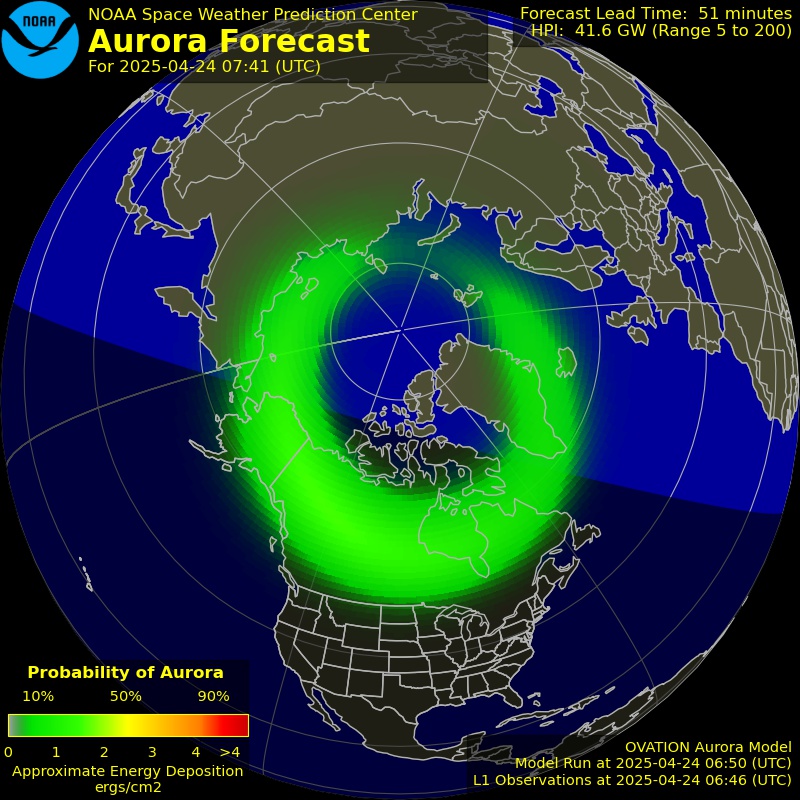
Data via NOAA SWPC · Updates every 30 minutes · Tap to open full forecast
Live Solar Wind · Bz and Speed
The last few hours of Bz behaviour. A single number tells you now. This tells you the story. Sustained negative Bz drives the show. A brief dip means little.
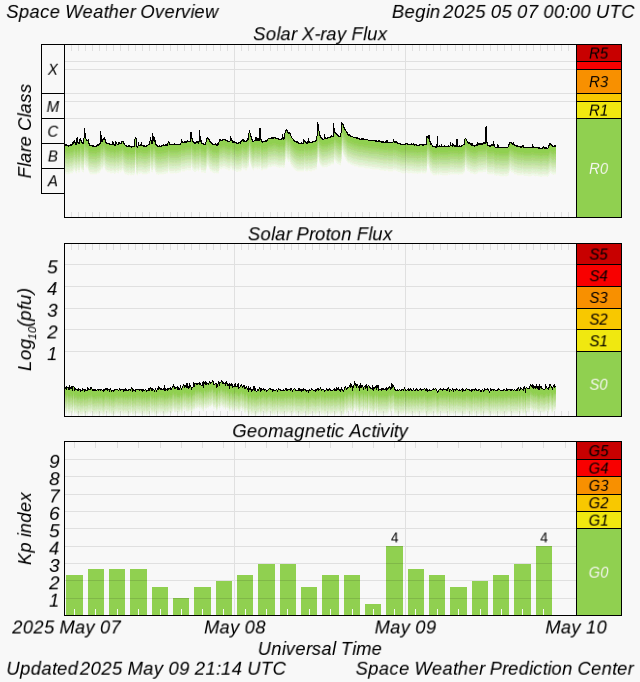
Data via NOAA SWPC · Updates continuously · Tap to open full dashboard
Moon Phase Calendar
The moon is your friend or your enemy tonight. Know which before you drive.
Calculated automatically · Updates each month
Check Your Sky
The data can be perfect and clouds can end your night. Check these before you drive.
Where you stand on Earth changes everything. The difference between Zone 1 and Zone 4 is not just distance, it is an entirely different relationship with the sky above you.
These zones and thresholds are approximations built from patterns, not guarantees. The same Kp on two different nights can produce entirely different results depending on Bz behaviour, solar wind density, and conditions we do not always see coming. Aurora is like the English language. It has rules, and then it breaks many of them. Use this as orientation, not instruction.
| Zone 1 · Sub-Arctic | 50°N+ · Moosonee, Red Lake, Kenora | The Corona, sometimes exploding overhead from the Zenith | Clouds & Cold | Bz slightly positive OK · 300+ km/s |
| Zone 2 · Northern Shield | 46–50°N · Sudbury, North Bay, Sault Ste. Marie | The Arc, sometimes high green curtains sweeping overhead | Clouds, Great Lakes moisture | Bz −2 to −5 nT · 400+ km/s |
| Zone 3 · Central Highlands | 44–46°N · Muskoka, Bruce Peninsula, Grey County | The Pillars, vertical fingers from the horizon | Terrain & Trees | Bz −5 nT sustained · 450–500 km/s |
| Zone 4 · Lower Lakes | 42–44°N · GTA, Hamilton, Niagara, Lake Erie, Sarnia, London | The Glow, deep red/purple tops of distant storms | Light Pollution | Bz −10 nT or lower · 600+ km/s |
The Vantage Point Zone, Muskoka, Bruce Peninsula, Grey County, the Escarpment, Barrie North
Here elevation is key to overcoming the atmosphere. You are too far south for the oval to be frequently overhead, so you rely on an unobstructed view. By finding high ground, like the Escarpment or certain elevated lookouts, you can physically look over the lower, thicker atmosphere to see the upper parts of the light show happening further north.
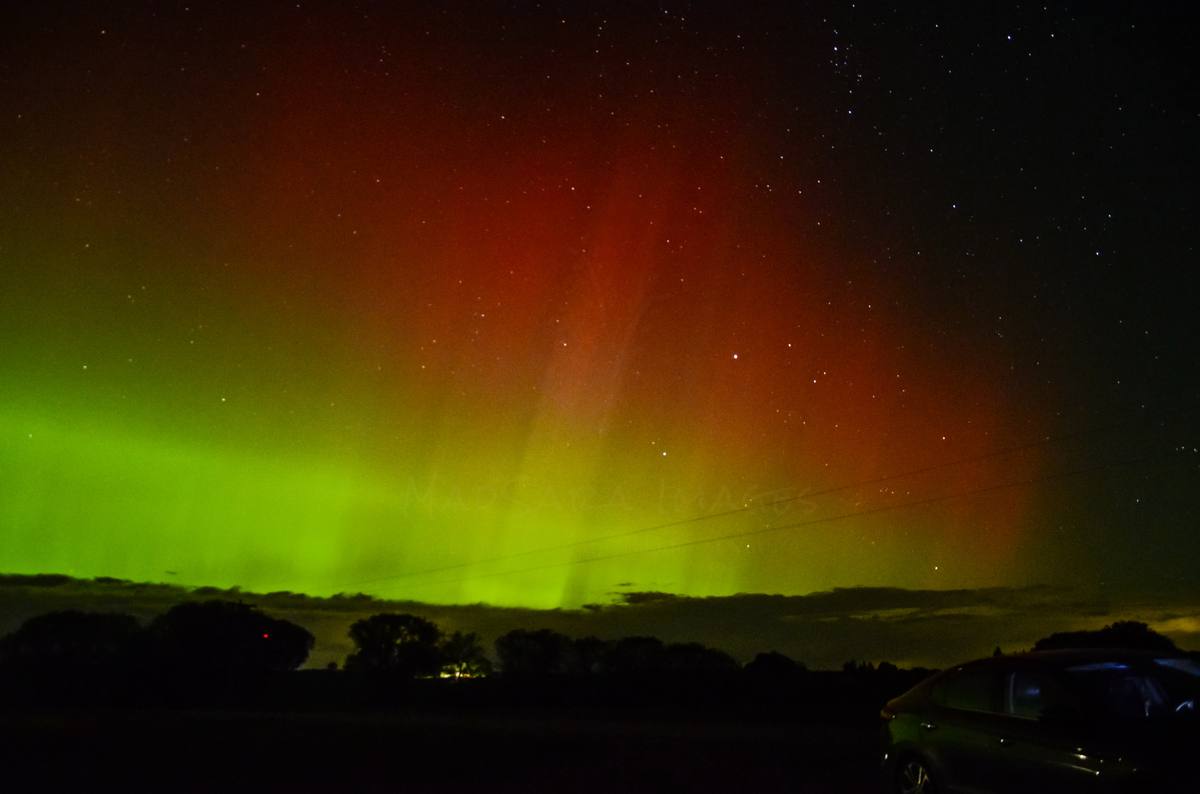
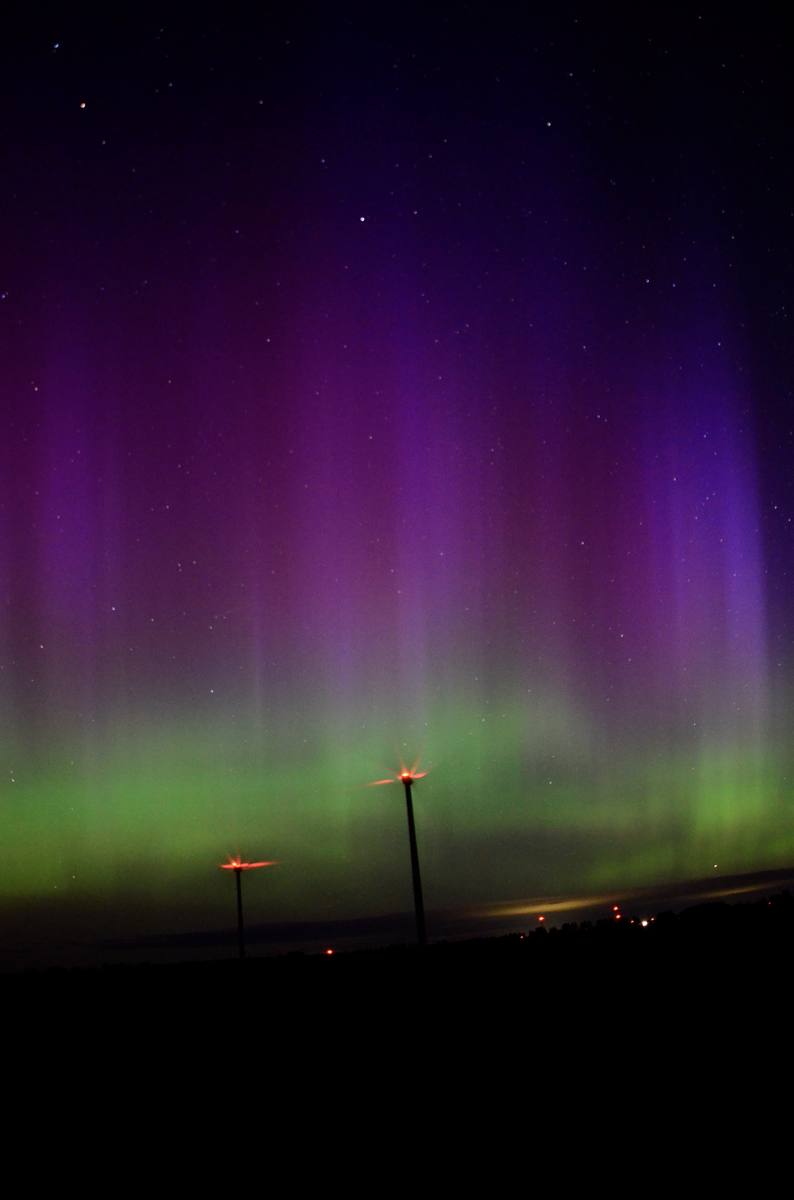
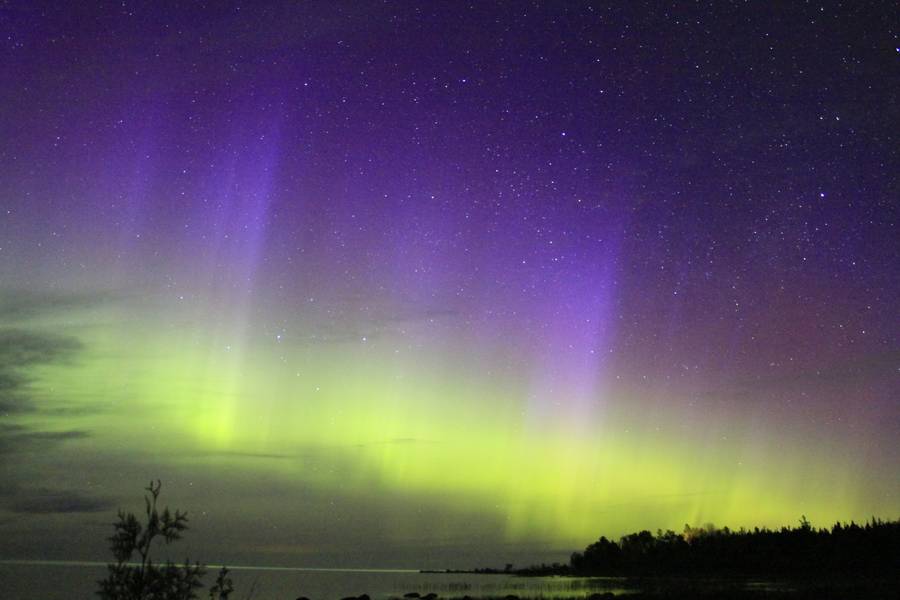
You are seeking vertical structures. The base of the aurora, the green arc, may be hidden by the horizon or distant obstructions. What you will sometimes see are the pillars: purple and red columns of light reaching high from the northern horizon. A faint shimmering on the northern horizon is often the aurora. A camera is essential to confirm colours before your eyes can fully adjust.
Zone 3 Typical Thresholds (approximate)
- Bz: Should be negative, −5 nT sustained
- Speed: 450 to 500 km/s. The solar wind must have enough force to push the oval this far south.
- Bt: 10 nT or higher
The Extreme Southern Challenge, GTA, Hamilton, Niagara, Lake Erie Shores, Lake Huron, Sarnia, London, and potentially every back road in between
Zone 4 Typical Thresholds (approximate, extreme)
- Bz: −10 nT or lower
- Speed: 600+ km/s
- Bt: 15 to 20 nT
If the graphs show minimal activity, stay home. Sometimes when these extreme conditions align, this region offers the rare, deep red auroras. Sometimes, but not every time, and it is important to know and respect that. When it does happen, it is worth every kilometre of dark road you drove to get there.
For those of us who push further from home base, the trip does not get planned around the aurora. You plan a camping trip and you plan it wisely. Watch the synodic cycle, check the seasonal variables, bugs in summer, smoke and heat in July and August, and let the sky decide what it gives you. We go north in the fall, Schreiber and Lake Superior country. Spring means Algonquin. The Bruce Peninsula shoreline is a closer reach when a window opens and you cannot justify the full north run. When you are already camped on dark water with a clear horizon, the aurora finds you. If the night does not perform, you are still somewhere worth being. Pack the camera either way. Fog on the lake at dawn, mist in the pines, the light that comes after a long dark night, that is not a consolation prize.
You do not have to drive hours past cities to see them; but you may need to drive an hour past your city to find a dark open area to park. From the GTA, lean southeast of Lake Simcoe rather than toward Barrie. Have multiple tested locations. When one horizon is socked in, another may be clear.
The Dance,
A Three-Act Symphony
From a latitude of 43–44° north, watching the aurora is an exercise in patience and timing as well as a serving of joy, wonder, exhilaration and awe. The phases, never quite exactly the same twice, move anywhere from a slow moving opera to a 90s basement back door techno rave, or both. Once you've stayed all night enough times you start to feel the pattern. You'll understand the quiet is another phase building up and not time to go home, and the entire show is pure awe, every time.
A Note on STEVE and the Picket Fence
These are real and documented phenomena; but the science community does not universally classify them as aurora, and some researchers feel quite strongly about that distinction. STEVE is caused by a fast-moving hot plasma ribbon in the ionosphere, an emission of heat, not particle precipitation the way true aurora is. Whether the green Picket Fence that frequently accompanies it is genuine auroral emission or something else entirely is still actively debated. The SAR arc adds further complexity, where one phenomenon ends and another begins is not always clean science. Observe it. Photograph it. Wonder at it. Just hold the label loosely, and if someone in the science community corrects you, they're probably not wrong.
And honestly? In the moment, standing in a dark field watching any of this unfold above you, the name doesn't matter one bit. The debate can wait until morning. What's happening in that sky is magic. Sit back and watch it.
Aurora colours are determined by which atmospheric gas is being excited and at what altitude. Understanding this explains why your camera sees colours your eyes cannot.
What Stands Between
You and the Lights
A clear sky on a weather app is only half the story. At 43.5°–45°N you are peering through hundreds of kilometres of low-altitude atmosphere on any given night. Here is everything that can stand between you and the lights.
- Light Pollution: Steady yellow or orange dome, stationary, always in the direction of the nearest town, greenhouse, or casino spotlight.
- Airglow: Faint green or red ripples across the whole sky. No vertical structure, doesn't dance. The debate in aurora communities can miss the point sometimes, if you feel a magical sense of wonder standing in a dark field, that is not wrong. It may not be "Aurora" but it's a place to learn and play with the night sky.
- Noctilucent Clouds: Electric blue/silver wisps after sunset in summer. At 80 km altitude, lit by the sun from below the horizon. Not aurora; but beautiful in their own right.
- Sensor Noise: Grainy green tint across everything including trees and ground. True aurora is only in the sky, never in the foreground.
There is much debate about the moon. Though if there are atmospheric elements at play this can be true, it's not the moon you loathe, it's those pesky layers of moisture, cloud, smoke and fog. The moon can actually be a useful tool for locking focus if stars aren't giving you enough contrast.
- New Moon / Crescent: Best for subtle shows. Darkest sky.
- Quarter Moon: Actually helpful, a soft lightbox illuminating your foreground for dramatic compositions.
- Full Moon: Sky lamp. Drop ISO to 800, use shorter exposures. Keep it behind you. If it casts your shadow on the ground, your sensor will be flooded, less ground, more sky.
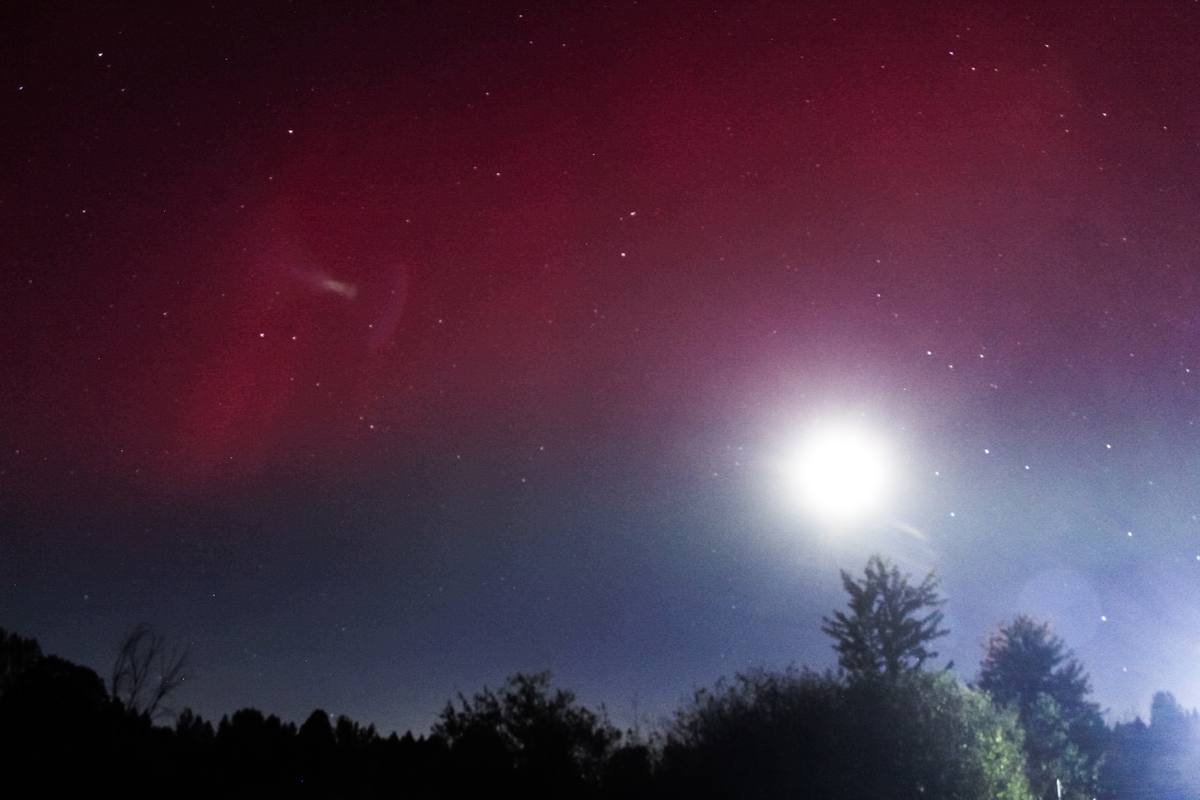
Ontario's transitional seasons are some of the best aurora windows of the year. The same conditions that make the sky perform are also the ones that will quietly ruin your shot. Dew forms fast on a cold lens and frost forms faster, either will soften your image so gradually you may not notice until you're home wondering why everything looks like it was shot through a shower door.
- USB lens warmer band, most reliable solution, costs very little
- Hand warmers from the dollar store taped to the barrel work surprisingly well; but if you add one after setting your focus, check focus again. The heat shifts the ring.
- Check your front element every 20–30 minutes
- Never breathe on a cold lens, makes it worse instantly
The Gear ,
Use What You Have
I shoot with a Canon T2i, a Canon T6, and a Nikon D7000. Kit lenses. My tripods are relics from Blacks, the film photography institution of the 80s and 90s, repaired and kept alive through what I will generously call field engineering. One of my T2i's has a mirror I reglued myself. The entire May 2024 G5 shoot was photographed through a Krazy Glue thumbprint. I still love that camera.
I tell you this because a common thing that stops new chasers from even trying is the belief that they need better gear or fancy cameras. Which you don't. You do need to go outside. The aurora does not care what camera you're holding. What separates a good aurora photograph from a missed one is almost never the equipment. It is being there, being ready, and understanding your light and getting to know your camera of choice in order to manipulate it. On quieter aurora nights, I call those teaching moments. Where I learn to use the time I've taken to learn something new in night sky shooting, the fields and shorelines are the best teachers but you need some simple basics first.
These settings are built from kit lenses at 44° north across hundreds of nights. Use them as your launch pad, not your destination. The best setting is always the one that captures what you're seeing. Adjust up or down to your suiting.
| Condition | ISO | Shutter | Aperture | Notes |
|---|---|---|---|---|
| Faint / Quiet Night | 6400 | 20–25s | f/3.5 | Finding the arc. Camera sees it before your eye does. |
| Moderate, Baseline | 3200 | 15s | f/3.5 | Your starting point every night. Dial from here. |
| Strong Show G3–G4 | 1600 | 6–8s | f/3.5 | Pull shutter first, then drop ISO if still blowing out. |
| Extreme Show G5 | 800 | 1–2s | f/3.5 | May still be too much. Adjust continuously. Enjoy every second. |
| Overhead Corona | 1600 | 1–2s | f/2.8 | Pillars move fast overhead. Point straight up. Don't overthink it. |
Three Rules That Don't Change
- Kill the Auto: Auto-focus hunts and fails in the dark. Auto-flash ruins every exposure within 1km. Auto white balance shifts your greens and magentas. Turn them all off.
- The 2-Second Timer: Never press the shutter with your finger during a long exposure. Always use a 2-second self-timer or remote release. Every time.
- RAW, always, non-negotiable: A RAW file is unfinished data. Your camera captures the ingredients; post-processing is the cooking. JPEG bakes in your settings and gives you almost no room to adjust. Shoot RAW. Always.
Most people standing in a dark field have a phone in their pocket and not a DSLR on a tripod. That's fine. Cell phones have come a long way and the most important thing they can do is confirm the aurora is there before you've even set up anything else. Point your phone at the northern horizon in Night Mode, if something green shows up on your screen that your eyes can't see, you're in business.
iPhone
Use Night Mode, it activates automatically in low light. For better results open the Camera app, swipe to Night Mode manually and set the exposure time to the longest available. Keep the phone completely still. A mini tripod or propping it against something solid makes an enormous difference. For video, tripod is non-negotiable. Handheld aurora video in the dark is unwatchable.
Android
Look for Pro Mode in your camera app. Set ISO to 1600-3200, shutter speed to 10-15 seconds, focus to manual infinity. If your phone has an Astrophotography or Night Sight mode, use it. Same rule applies: still phone, stable surface, tripod if you have one.
Google Pixel
The Astrophotography Mode in Night Sight is genuinely impressive for a phone, it stacks multiple exposures automatically. Set your phone on a stable surface, open Night Sight, and let it do its thing. Patience required, it takes several minutes to build the image but the results can be remarkable.
All Phones, The One Rule
A phone pressed against your face with your arm extended is the worst possible aurora camera. Stable surface or tripod, every time. Even propped against a rock on a fence post beats handheld by a mile. For video especially, if it's not on a tripod, don't bother. The aurora moves but it doesn't move fast enough to justify shaky footage.
Full device-specific guides with sample settings coming as standalone articles at madsaraimages.com.
Sky Heavy, Let the Show Breathe
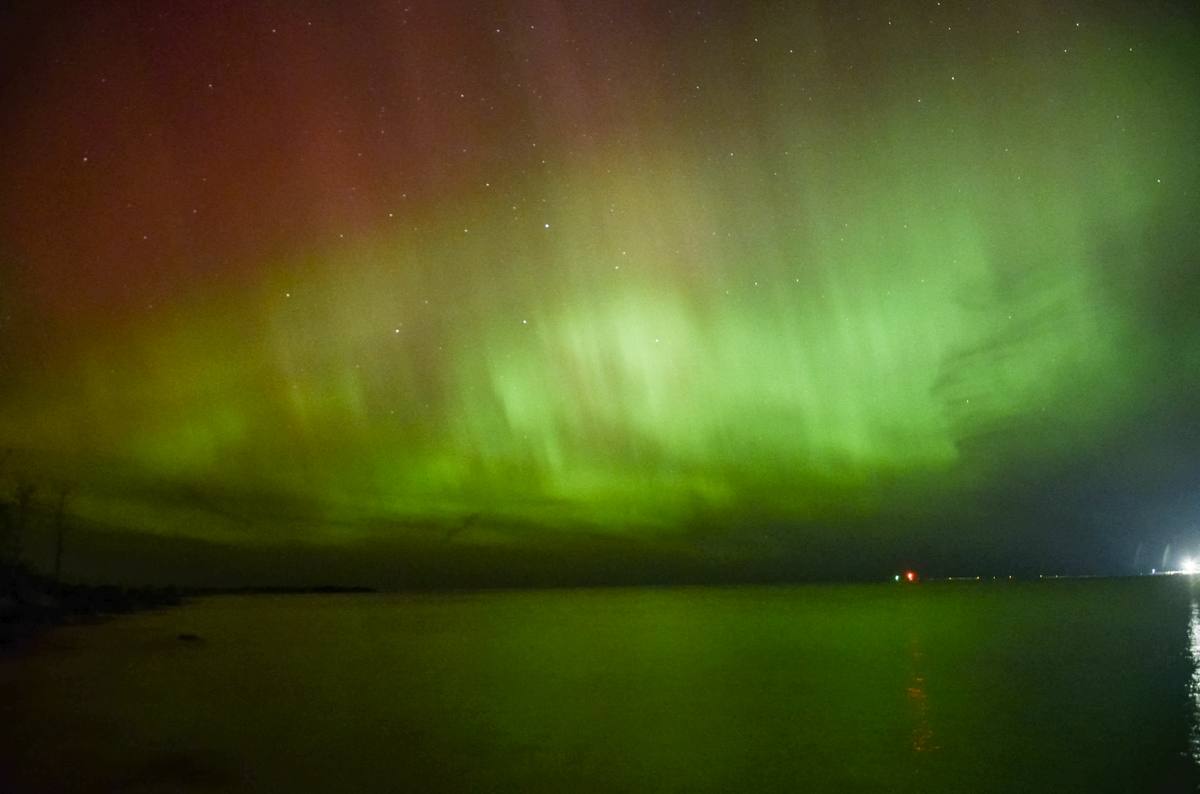
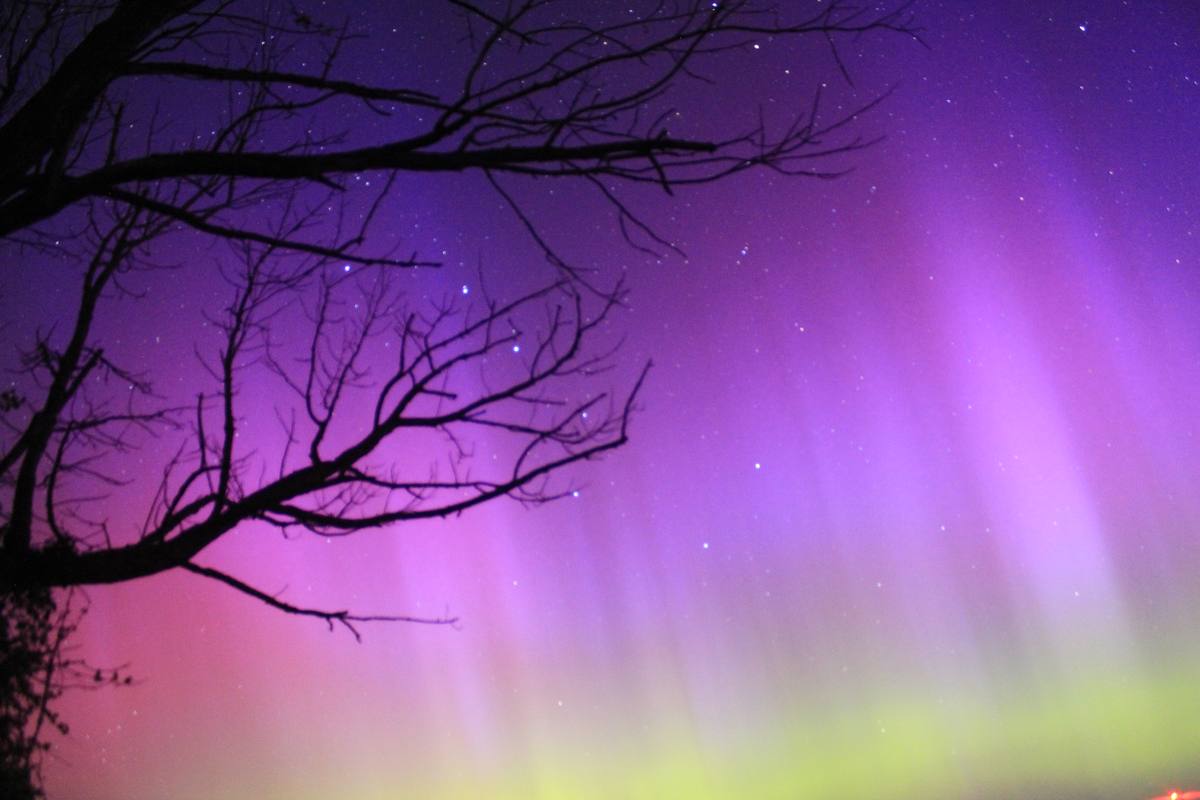
The most common mistake is giving too much frame to the ground. Aurora is a sky event. Place your horizon in the lower quarter of your frame, roughly one quarter ground, three quarters sky.
Water, Your Best Compositional Friend
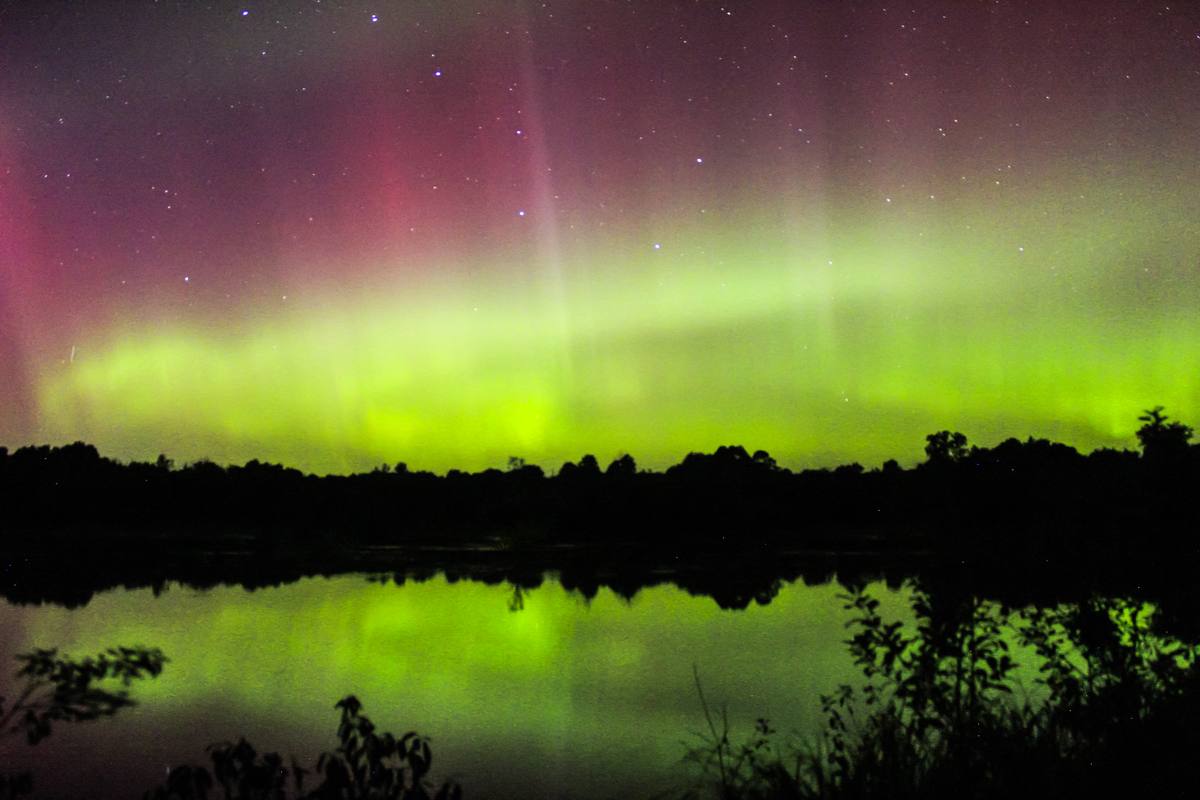
If one location has open water to the north, take it every time. Water reflects the light, doubles your colour, and gives you a natural leading line. Large open water like Lake Huron means no light bleed from the far shore, just uninterrupted dark horizon exactly where you need it.
The Human Element
One compositional choice transforms an aurora photograph into something that stops people mid-scroll, put a person in it. A single silhouetted figure on a shoreline gives the entire image its emotional weight. It tells the viewer how small we are under that sky. It doesn't need to be staged. It just needs to be there.
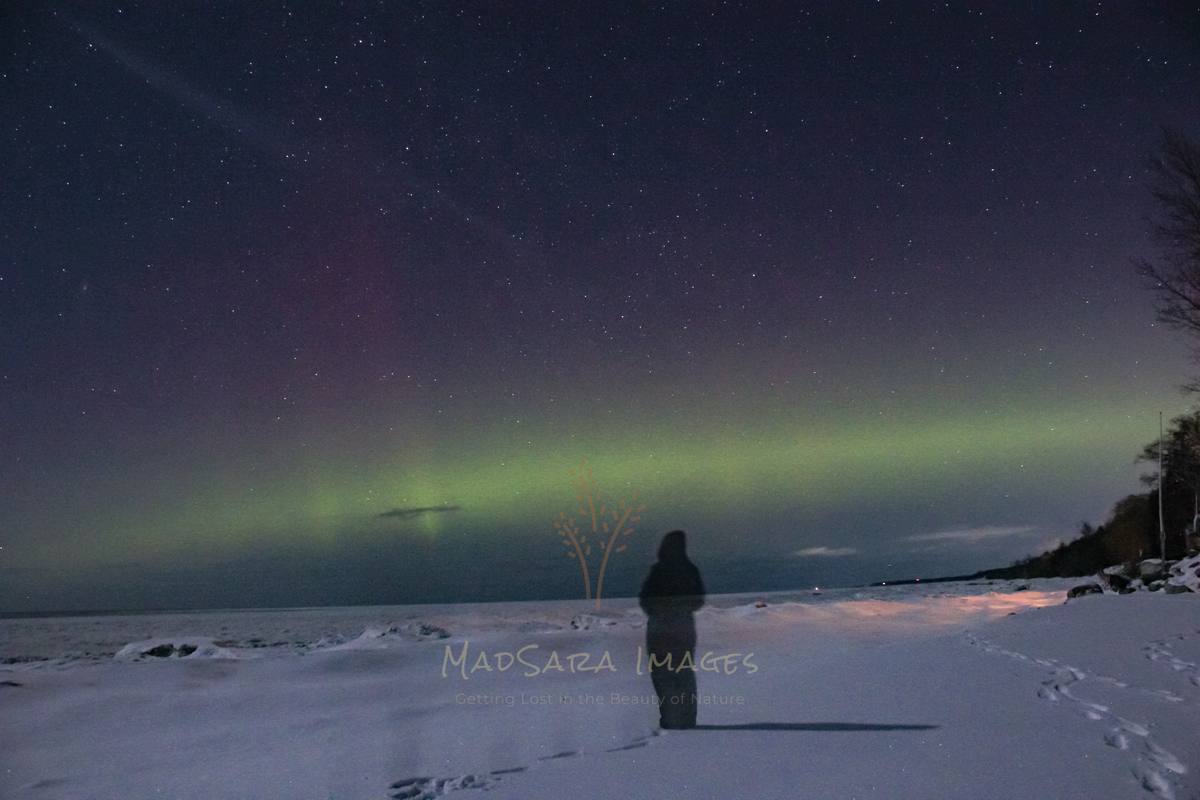
The chase looks different every time.
Chase Etiquette ,
Respect the Road, the Land, and the Light
After years of chasing I have seen things on rural Ontario highways that would make your hair stand up faster than a G5 storm. Highway 21 at midnight, cars stopped dead, not pulled over, not on the shoulder, dead centre of the road because someone saw green on the horizon and forgot they were operating a vehicle. Please don't be that person.
Find a safe and complete pull-off before you stop. A public conservation area, a municipal lot, a wide shoulder, anything that gets your vehicle fully off the road. The aurora will wait the two minutes it takes to park safely. The car behind you may not.
Ontario is massive. You do not need to crowd the same three spots everyone posts about online. I have watched a beloved night sky preserve here in Ontario deteriorate over five years from a quiet sanctuary into a road lined with fast food garbage and worse. The parking lot holds fifteen cars for a reserve that protects endangered flora and species that were there long before any of us pointed a camera at the sky.
Please think beyond the famous spots. Explore. Ontario rewards the curious chaser generously. If you do arrive somewhere another chaser is already set up, lights off, voices low, give them their space. We are all out here for the same silent magic.
White light is the enemy of dark adapted eyes and long exposures alike. Use a red light torch for everything once you leave your vehicle. One careless flashlight can ruin an exposure that took minutes to set up. A cheap hack is a dollar store flashlight and a small piece of Tuck tape over the lens.
I pick up garbage almost every time I go out. Not righteously, rightfully. Every dark sky location you visit is someone's home, someone's livelihood, or someone's protected wilderness. Pack out everything you brought in. Stay on the paths. The aurora community in Ontario is small enough that word travels fast.
Use the Light Pollution Map at lightpollutionmap.info to find dark sky zones overlaid on a map of public access areas. The reader finds their own spot using the tool, that skill serves you for life. Aim for Bortle Class 4 or lower when hunting from the GTA corridor. Have multiple tested locations so when one horizon is socked in, another may be clear.
The Night the Water
Looked Like Sunrise
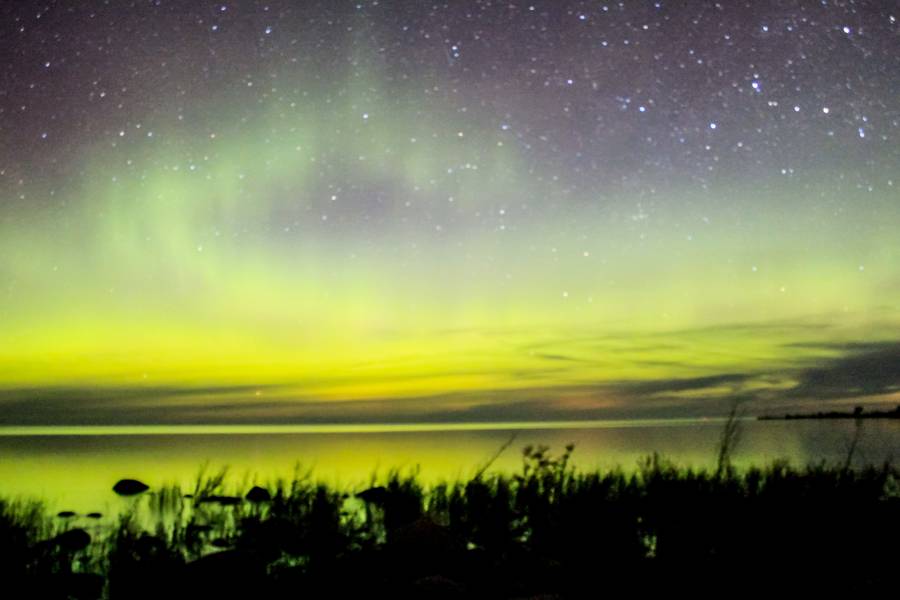
My first night shooting aurora was May 2017. No tripod, camera propped between rocks on the shore. We were camping on a small peninsula open to the water with about a 120 degree view of Lake Huron, and the water started to look like the sun was coming back up. I've spent my whole life in one way or another on the lake so I'm familiar with the lighting as a peripheral instinct. I said to Tony, it seems like the sun is coming back up, or the moon is, but they've both just set. This was Bruce County. A G3. I had no idea. Seasoned chasers to the north pointed me toward the data afterward.
For the next three to four months I'd pack us up and head back up every week to see what I could see. Then in September, in nearly dusk, the sky started lighting up to the naked eye just a side road from where I lived. I'd been out shooting the contrast of a shelf cloud coming in from the southwest over a bean field when the notifiers started going off. I went back out at dusk with my short lens and learned something, why am I driving anywhere unless I'm driving extreme north for a whole different experience? I don't need to go far. I began to tinker with locations and eventually found my triangle of spots. That has since expanded to six locations I move between.
I have shot aurora on nights there were no notifications. I have felt let down on many nights there were. My best advice is to learn as much as you can from the patterns. If you're really interested in catching the shows you have to learn the quiet times too, the Kp 2.67 where you look at the oval and think, hmm, I'll give it a whirl. It helps if you're someone at war with sleep.
Happy Chasing Friends.
Ready to Chase?
0 / 0 complete
Activity data is probabilistic. Always verify with SpaceWeatherLive before you chase.
Every night in the dark has its own reward., Sara
A quick-reference guide to the language of the sky. Flip here when you hit a term you don't know.
| Short | Full Name | What it means for you |
|---|---|---|
| Bz | IMF North-South Component | The magnetic key, should be negative to open Earth's shield |
| CME | Coronal Mass Ejection | The cannonball, triggers the biggest storms |
| CIR | Co-rotating Interaction Region | The 27-day recurring driver, most predictable aurora source |
| HSS | High Speed Stream | Fast solar wind from a coronal hole |
| Kp | Planetary K-index | 0–9 storm gauge. Use live data for real-time decisions. |
| IMF | Interplanetary Magnetic Field | The Sun's magnetic field carried through space by solar wind |
| DSCOVR | Deep Space Climate Observatory | Gives us 30–60 min advance warning on solar wind |
| NOAA/SWPC | Space Weather Prediction Center | Official alerts, forecasts and live solar wind charts |
| nT | nanoTesla | Unit of magnetic field strength, the Bz number you watch |
| G-Scale | Geomagnetic Storm Scale | G1 (minor) to G5 (extreme); G3+ usually reaches mid-latitudes |
| CH | Coronal Hole | Open magnetic region on the Sun, source of HSS and CIRs |
| UTC | Coordinated Universal Time | All space weather data uses UTC, know your offset |
SpaceWeatherLive
Your primary dashboard. Real-time Bz, speed, Kp, notifications. Start here. Always.
spaceweatherlive.comAstrospheric
Gold standard for transparency, smoke layers, dew point. Run before every chase.
astrospheric.comNASA Solar Dynamics Observatory
Continuous HD full-disk views of the Sun across multiple wavelengths. Watch coronal holes develop and rotate into Earth-facing position.
sdo.gsfc.nasa.govNOAA SWPC Enthusiasts Dashboard
Hourly Kp updates, real-time solar wind metrics and 3-day space weather forecasts in one place. Bookmark this.
swpc.noaa.gov/enthusiasts-dashboardNOAA Space Weather Scales
Defines G1–G5 storm levels, what they mean for your latitude, and what conditions are required. Know the scale.
swpc.noaa.gov/noaa-scalesESA Space Weather Portal
Navigate the solar disk in real-time, view coronal holes and filaments overlaid, track their position relative to Earth.
swe.ssa.esa.intLive Aurora Cams
Real-time aurora camera feeds across North America. See what is happening east of you before it reaches Ontario.
liveauroracams.comOntario 511 Cams
Highway cameras, check if a clear forecast is actually foggy before driving north.
511on.ca